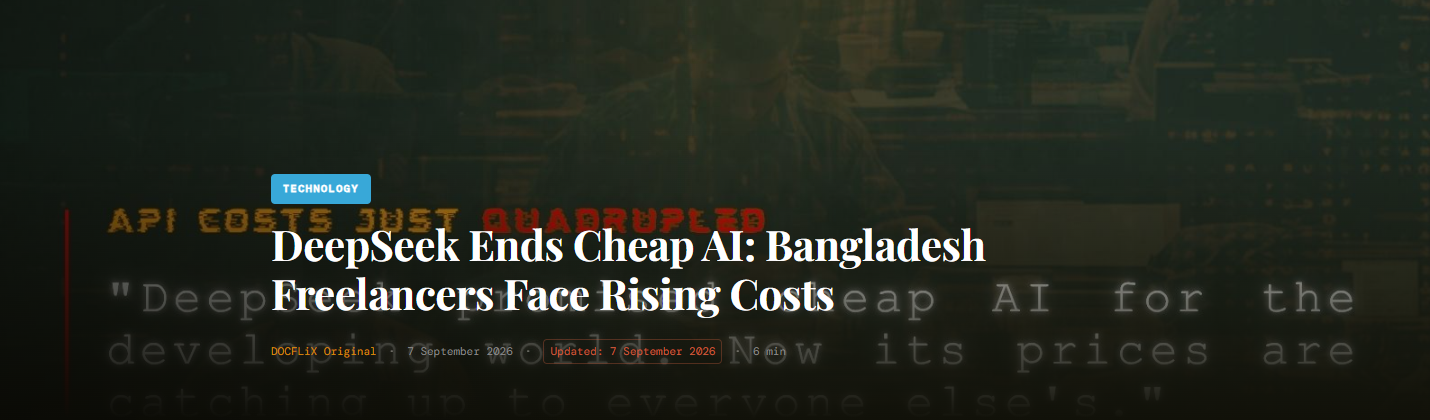
Eighteen months after crashing Nvidia's stock with the promise of ultra-cheap, open-weight AI, the company that started the revolution is rewriting the rules. DeepSeek is heading toward a massive public listing, and its pricing is rapidly aligning with the rest of the tech industry.
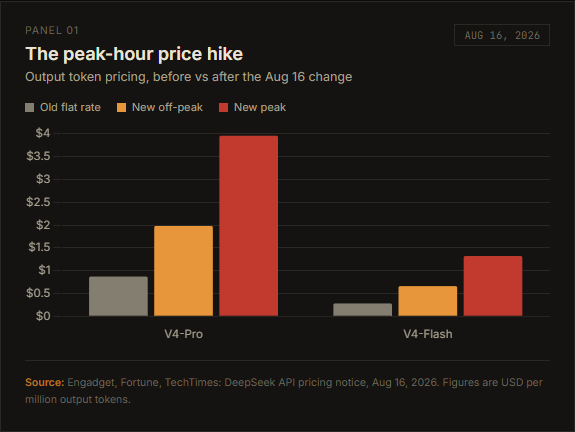
On August 16, 2026, DeepSeek quietly dismantled the pricing structure that established its global reputation. The Chinese AI lab introduced peak and off-peak billing for its flagship APIs. Output prices for the V4-Pro model surged from 87 cents to $3.96 per million tokens during peak hours—a more than fourfold increase. The lightweight V4-Flash model jumped from 28 cents to $1.32. The permanent, flat-rate pricing established just three months prior, in May, was completely erased.
The company softened the blow a week later. On August 23, DeepSeek stopped distinguishing between peak and off-peak hours on weekends, allowing Saturday and Sunday usage to be billed at the cheaper rate around the clock. While this provides breathing room for software teams that can shift asynchronous batch jobs to weekends, it does not alter the fundamental reality: weekday peak rates are quadruple their July level, and the vast majority of commercial client work takes place within standard weekday hours.
The Company That Broke the Old Math
To gauge the magnitude of this pivot, one must revisit January 27, 2025. On that afternoon, Nvidia surrendered nearly $600 billion in market value during a single trading session—the largest one-day valuation decline for any enterprise in US stock market history.
The shock originated from a research paper published out of Hangzhou. DeepSeek had open-sourced R1, a reasoning model that matched OpenAI's elite o1 system across standard mathematics and software engineering benchmarks. Crucially, the research indicated that training required only a modest fraction of the computational capital deployed by American hyperscalers. Wall Street concluded that if frontier AI development no longer required endless clusters of elite hardware, the monopoly margins commanded by hardware vendors were untenable. Nvidia shares plummeted 17 percent by the closing bell.
The accompanying narrative captured global interest: cheap, open-weight architectures would democratize cutting-edge computing. Emerging markets, with Bangladesh frequently highlighted by international analysts, were heralded as the immediate beneficiaries of an accessible AI stack.
From Disruptor to IPO Heavyweight
Eighteen months later, DeepSeek functions less like an insurgent open-source research lab and more like an established corporate giant. In April 2026, the lab carried an estimated private valuation of $10 billion. By June, it concluded an initial outside investment tranche of $7.4 billion at a $50 billion valuation, financed by Tencent, CATL, JD.com, NetEase, and China's National AI Industry Investment Fund.
The subsequent capital raise proved more volatile. Negotiations for an additional $8 billion round at a $74 billion valuation opened shortly after June. On July 25, DeepSeek temporarily paused discussions following the leak of an internal transcript where founder Liang Wenfeng candidly addressed the firm's ongoing reliance on Nvidia hardware and the persisting technology differential between Chinese and American foundational labs. Talks resumed in early August, bringing institutional participants such as Monolith Management into formal syndication discussions.
The resulting revaluation elevated Liang to the wealthiest figure across the global AI landscape, with an estimated net worth of $36 billion on Bloomberg's billionaire index, surpassing Anthropic's Dario Amodei and OpenAI's Greg Brockman.
Governance records indicate Liang retains decisive voting control via a dual-class equity framework. Outside commercial investors face five-year lockup provisions stripped of voting participation, leaving China's state AI fund as the sole external entity holding both a board seat and formal voting rights. With DeepSeek actively preparing documentation for an initial public offering on the Chinese mainland aimed for 2027, the commercial mandate has shifted from subsidized disruption to fiscal sustainability.
Cheap AI Didn't Die. It Changed Address.
The upward price revision at DeepSeek does not signal the collapse of open-weight utility; rather, market leadership has fractured across alternative providers.
In June 2026, Alibaba reduced pricing on its Qwen suite by 40 percent. Moonshot AI introduced Kimi K3 in July, prompting an operational surge that forced new registrations to pause within 48 hours. Parallel architectures from Z.ai (GLM) and Europe's Mistral continue to undercut DeepSeek's active peak pricing schedules.
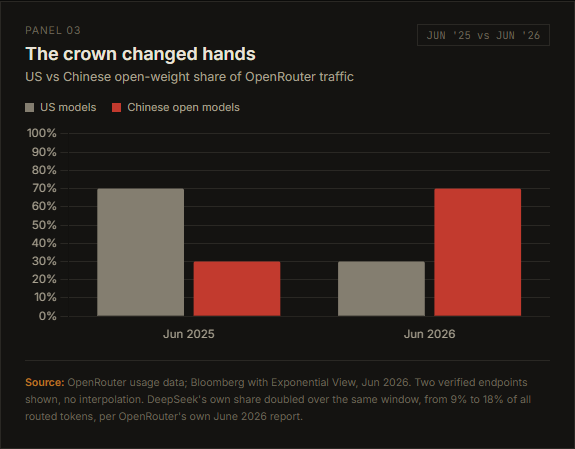
On aggregate, Chinese open-weight architectures have dominated global routing volumes. Twelve months ago, proprietary US models commanded approximately 70 percent of all computational requests processed through OpenRouter, the leading vendor-neutral orchestration platform. By mid-2026, American model utilization receded to 30 percent, with open-weight alternatives capturing the remainder. DeepSeek maintains the position of OpenRouter's largest single supplier, accounting for roughly 18 percent of total routed token throughput.
The Squeeze on Bangladesh's Freelance Economy
For Bangladesh, the transition toward costlier model inference is not an abstract market development; it strikes directly at service margins across the digital services sector.
The country maintains one of the world's dense freelancing ecosystems, encompassing over 650,000 independent practitioners contributing more than $500 million annually in inward foreign exchange. Outsourcing across IT-enabled services (ITES) reached $900 million in the initial half of 2025 alone.
In current production workflows, generative AI interfaces function as core computational utilities. The per-token tariff assessed against automated translation pipelines, full-stack software development assistants, and programmatically generated editorial assets determines the net profitability of an export contract. When API overhead quadruples during daytime peak periods, independent contractors absorb the difference.
Domestic administrative policy has advanced slower than market realities. The consultation window for Bangladesh's National AI Policy (2026–2030) concluded on February 8, 2026, but the document remains under administrative review within the ICT Division without an established operational timeline. Regional counterparts, including Sri Lanka and Nepal, ratified structured national AI frameworks prior to Bangladesh's completion.
A joint readiness audit executed under UNESCO and UNDP auspices identified persistent institutional challenges:
- Siloed ministerial data architectures
- Acute national GPU deficits
- Curricular misalignment across secondary and tertiary education
- An absence of formal machine learning ethics standards
- A substantial gender disparity throughout technical engineering teams
Hardware deployments remain experimental. In January 2026, the Bangladesh Hi-Tech Park Authority (BHTPA) and the Bangladesh Computer Council's National Data Centre activated 20 previously dormant Nvidia Volta Tensor Core GPUs. Providing a compute density roughly comparable to 900 standard CPUs, the cluster represents the nation's sole shared public-sector machine learning facility. Eight months post-commissioning, it remains the extent of state-provisioned compute.
The True Cost of Tech Independence
Sustainable adaptation within Bangladesh has consequently occurred through distributed open-source initiatives rather than single-vendor dependencies.
Academic and independent collectives continue downstream optimization using adaptable model weights. Frameworks such as BanglaLlama and TigerLLM—fine-tuned adaptations derived from Meta's open architectures—leverage localized instructional datasets, the national primary curriculum, and university volunteer pipelines. Simultaneously, the Bengali.AI consortium continues archiving public benchmarking assets covering regional phonetics, handwriting, and layout analysis, while research groups at BRAC University produce novel translation baselines for colloquial Bangla dialect structures.
The enduring lesson of DeepSeek's monetization is structural: real computational sovereignty cannot rely on the discretionary pricing schedules of an external vendor. The sustainable assets of the AI economy are the compute clusters, regulatory frameworks, and native-language corpuses retained under national jurisdiction. As overseas vendors adjust their commercial balance sheets, the definitive metric remains whether domestic digital infrastructure can scale to support local production.